Reading Canberra: How Parliament, Memorials and Protest Tell Australia’s National Story
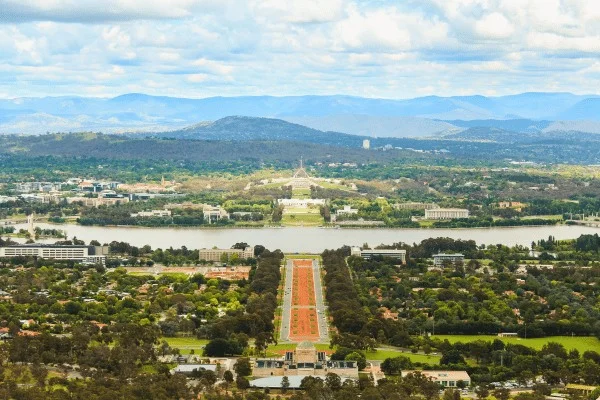
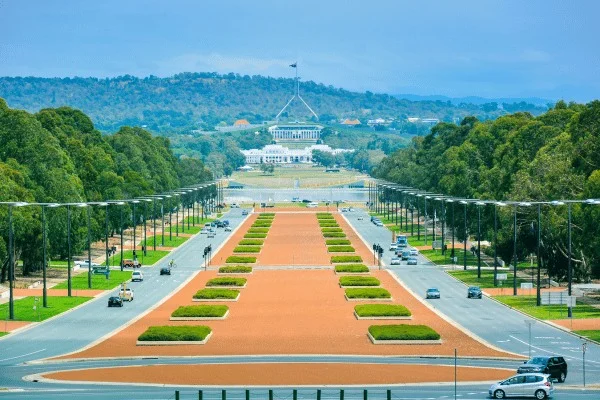
Canberra gives you room to look. Long views run between hills and public buildings, while lawns separate institutions that would be squeezed into neighbouring streets in many older capitals. Those long views are part of Canberra history: designers gave national institutions room to be seen. Public protest later challenged decisions made inside the same buildings.
A parliament expresses an idea about government. A memorial chooses a way to remember loss. A protest camp can challenge the decisions being made within sight of it. Canberra contains all of these, and their proximity creates opportunities to consider how a national story is made and disputed. You do not need to agree with every inscription to learn from reading it carefully.
Trippy Tour Guide's paid Canberra Power, Peace and History walking tour offers audio context for exploring the capital. The original planning competition and later commemorative projects help explain why these institutions occupy such a conspicuous part of the capital.
The planned capital occupies a much older cultural landscape
The National Capital Authority acknowledges the Ngunnawal people as the traditional custodians of the ACT, while recognising other people and families with connections to the region. The federal capital's foundation belongs within that longer history. A twentieth century street plan is evidence of a new government project, not the beginning of human relationships with the place.
The decision to establish the capital here followed debate over the location of Australia's federal government. The Canberra district was selected in 1908. An international design competition followed in 1911, and the proposal associated with Walter Burley Griffin and Marion Mahony Griffin won in 1912. Canberra received its name in 1913. The arrangement of major avenues and the central triangle still reflects that planning ambition.
A useful way to look at the city is to compare the geometry on a map with the land beneath it. Hills provide endpoints for views, and open areas allow buildings to be seen from a considerable distance. Those relationships explain the capital's visual order. They do not explain every experience of living there, which also depends on ordinary homes, workplaces and the communities outside the ceremonial centre.
Canberra's long views connect the lake, formal avenues and surrounding hills.
Old Parliament House and early federal government
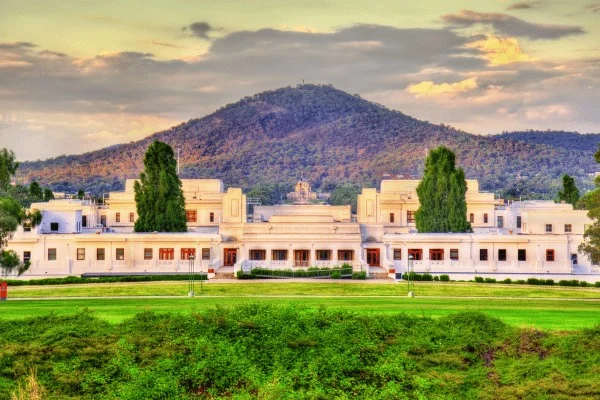
Old Parliament House opened on 9 May 1927 and accommodated the federal Parliament until 1988. John Smith Murdoch designed a building intended to serve provisionally while a permanent home remained a future project. Its white exterior and comparatively low profile are a reminder that the monumental capital visible today developed over decades.
The building's rooms bring political history down to a human scale. Offices, corridors and chambers were workplaces, with staff and politicians trying to manage a growing national administration within a limited structure. The Museum of Australian Democracy records practical adaptations during the Second World War, including white lines on paths to help people find their way during blackout conditions. Such details explain daily life more clearly than a sequence of prime ministerial portraits alone.
It is worth distinguishing a building's architectural intention from what happened inside it. Orderly symmetry could not guarantee orderly politics. Parliament's own history places the dismissal of the Whitlam government in 1975 among the major events associated with the old building. A calm facade can therefore hold memories of severe constitutional conflict. Read both the design and the documented events, without assuming that one is an illustration of the other.
The current Parliament House makes an architectural claim about democracy
The permanent Parliament House opened in 1988. Mitchell/Giurgola & Thorp's design was selected in 1980 from an international competition with 329 entries. The Parliamentary Education Office describes a building organised into areas for the chambers, the executive and shared facilities. Its scale reflected the requirements of a much larger institution than the provisional building could accommodate.
The hill and landscaped roof are central to the building's public meaning. The design incorporates the landform, allowing the landscaped roof to continue the shape of the hill. Parliament's interpretation connects this relationship to ideas about public access and democratic government. Architecture can express those aspirations even though the actual work of accountability takes place through political processes.
Look at the relationship between the building and the view beyond it. The capital's institutions were planned to be seen in relation to one another, although later choices changed parts of the original scheme. The paid Canberra Power, Peace and History audio tour supplies historical context while you explore. For the building itself, notice how entrances and public areas establish different degrees of access within a place that is also a working parliament.
The Tent Embassy brought a challenge to the parliamentary landscape
On 26 January 1972, Michael Anderson, Billy Craigie, Bertie Williams and Tony Coorey established the Aboriginal Tent Embassy opposite Old Parliament House. The first shelter was a beach umbrella. Their action opposed the McMahon government's approach to Aboriginal land rights and made a political claim in one of the country's most visible spaces. The name 'embassy' was itself a pointed comment on the treatment of Aboriginal people in their own country.
The National Museum traces changes in the protest's location and organisation over the following decades, with a permanent presence reestablished on the site in 1992. That history should not be compressed into the suggestion that an unchanging camp stood there continuously from the first day. Nor should the Embassy be presented as a single voice that speaks for every Aboriginal person.
The location helps explain its force. A visitor looking towards the former seat of federal power also encounters a demand addressed to that power. Treat the Embassy as a place of continuing political significance. Read the information provided, respect any requests about photography, and avoid treating people or their possessions as props in a photograph of the surrounding national buildings.
The War Memorial brings museum evidence into a place of mourning
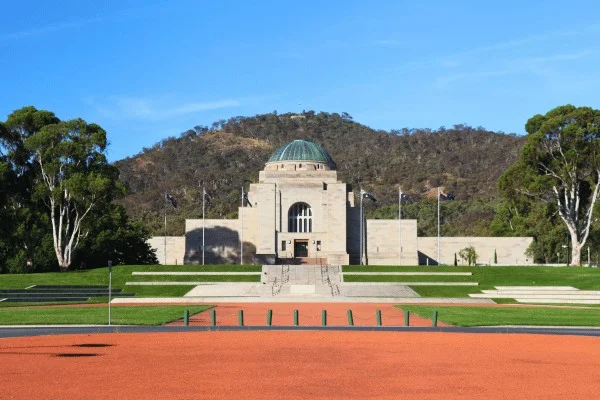
The Australian War Memorial opened on 11 November 1941, during the Second World War. Its origins lay in the experience of the First World War and in the work of war correspondent and historian Charles Bean. Collections of objects and records were intended to help explain experiences that a conventional monument could not fully convey.
Time in the museum galleries can feel quite different from time in the commemorative spaces. A gallery invites you to inspect evidence and ask how it has been selected. A commemorative space may ask for quiet attention to individual names and lives. Neither response requires rushing to the next display. A letter or personal object can narrow the distance between an immense conflict and one person's limited knowledge of what would happen next.
The institution's own history records Bean's hope that understanding war would contribute to peace. That hope does not remove the need to question how wars are represented. Notice the dates covered by a display and the kinds of evidence it uses. A service record, a painting and a recollection made years later answer different questions. Reading them together helps preserve both the human significance of the material and the care needed to interpret it.
Canberra monuments: water and sound at the Navy Memorial
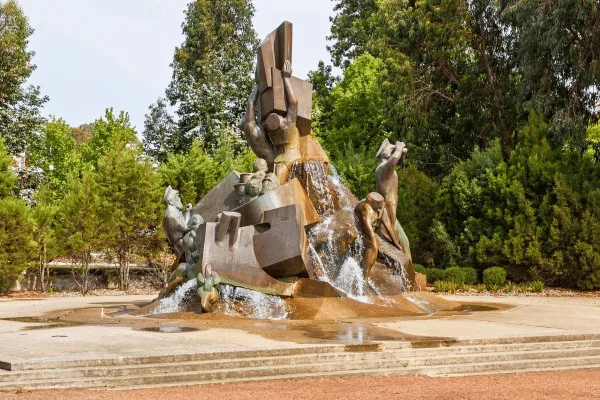
The Royal Australian Navy Memorial, also called 'Sailors and Ships', uses water to suggest the movement of vessels. The National Capital Authority describes a bow wave, turbulence and other sounds within the sculpture. Geometric forms represent a ship, while figures suggest different naval ranks and activities. These features reward attention at a smaller scale than the broad view along a ceremonial avenue.
Ante Dabro's design was selected through a competition, and the memorial was unveiled in 1986. The Navy's account also records that three serving members assisted the sculptor with fabrication. That detail joins the making of the artwork to the service it commemorates. The finished memorial is a public object with its own design and construction history, as well as a place of remembrance.
When considering any memorial, give the physical experience time to register before deciding what it means. Does it direct your gaze towards a name, a figure or an empty space? Is there somewhere to pause without blocking others? Such questions do not require specialist art vocabulary. They help explain how a designer has made room for individual reflection within a landscape also used for large public ceremonies.
Reconciliation and peace have their own places in the capital
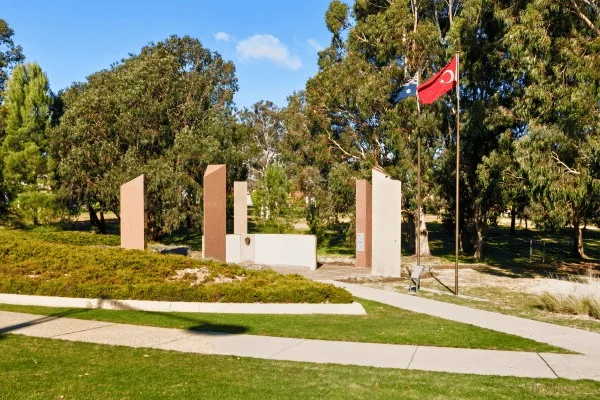
The Kemal Ataturk Memorial grew from Australian and Turkish commemorative gestures marking the seventieth anniversary of the Gallipoli landing. It honours Ataturk, who commanded Turkish forces during the campaign, and recognises the sacrifice of both Turkish and Anzac troops. Soil from Anzac Cove was placed beneath its dedication plaque. Its crescent shaped wall draws on the Turkish flag.
This is an example of remembrance changing the relationship between former enemies. The historical fighting remains part of the account, but later diplomatic decisions determine how it is publicly remembered. An inscription or design element therefore tells you something about the period when the memorial was made as well as the period it commemorates.
Peace Park offers another approach. Commissioned in connection with the United Nations International Year of Peace in 1986, it was dedicated in 1990. The central granite feature includes the word 'Peace' in the United Nations' six official languages and the local Ngunnawal language. Its presence near national institutions gives visitors a quieter place to consider the aims of government and international relations. The park's small scale is part of the experience; it does not need to compete visually with the larger buildings around it.
Look for the choices behind what is displayed
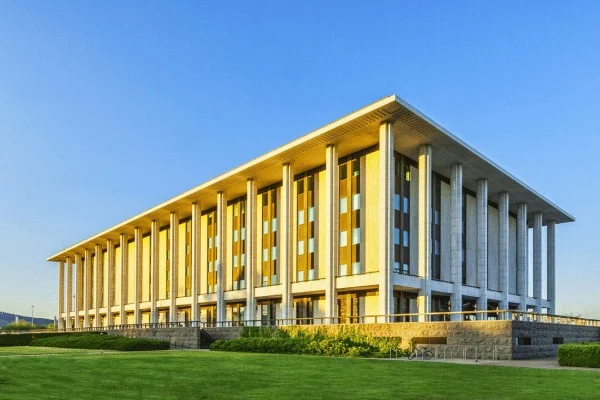
A capital cannot display every part of a country's history with equal prominence. Some stories occupy major buildings, while others appear through temporary exhibitions or public protest. The National Library offers a useful reminder of the material behind those choices. Its present building opened in 1968, bringing together collections and staff that had previously been spread across Canberra. The purpose extends beyond the imposing exterior to the preservation of records that later readers may interpret differently.
Allow time for that difference between a view and an explanation. A distant building can establish the composition of the city in seconds. Understanding an exhibition, a dedication or the history of a protest takes longer. You may leave with a more complicated impression of Canberra than the one suggested by its clean lines, and with specific questions to investigate in the institutions' collections.
Choose a manageable amount to consider in one visit, especially when the subject matter is demanding. Check current visitor arrangements with the institutions you intend to enter. Trippy Tour Guide's paid Canberra Power, Peace and History walking tour can add spoken historical context to your time in the city, while the public buildings and memorials give you the physical evidence to look at for yourself.
Frequently asked questions
Why does Canberra have two Parliament Houses?
The building opened in 1927 was a provisional home for the federal Parliament. It remained in use until the permanent Parliament House opened in 1988. Old Parliament House now houses the Museum of Australian Democracy.
When did the Aboriginal Tent Embassy begin?
It began on 26 January 1972 opposite Old Parliament House. Its history includes relocations and changes in organisation, followed by a permanent presence reestablished at the site in 1992.
Are Canberra's memorials only about military victory?
No. Their purposes and designs vary. Some focus on service and loss; the Ataturk Memorial reflects later reconciliation, while Peace Park was created specifically as a place to contemplate peace.
What is the best way to approach the national buildings?
Read the building's history alongside what you can see. Separate the architect's intentions from the events that occurred there, and leave time for collections or interpretation that complicate the first impression.
What can Canberra monuments tell me beyond the names they commemorate?
Their materials and arrangements reveal decisions about remembrance. The Navy Memorial uses water and sound to evoke ships, while Peace Park includes the word Peace in several languages. The Ataturk Memorial records a later relationship between former enemies. Read the dedication alongside the physical design to understand what each was intended to communicate.