How the Gold Coast Became Australia’s Playground: Surf Culture, Skyscrapers and Reinvention
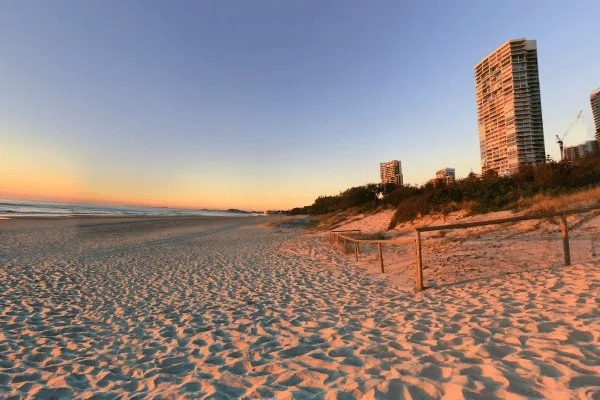
The Gold Coast's skyline runs so close to the surf that the two can seem to belong to the same natural formation. They have very different histories. The headlands took millions of years to form. The towers arrived within living memory, as a succession of developers and holiday businesses sold Australians a particular idea of life beside the sea.
That speed of change explains much of the city's character. A hotel helped give a suburb its name. A bridge made a coastal settlement easier to reach. Parking meters became an excuse for an international publicity campaign. To understand Gold Coast history, it helps to look at these small decisions alongside the broad sweep of beaches. The resort image was built, promoted and repeatedly revised.
Trippy Tour Guide's paid Gold Coast walking tour adds local stories to a visit, with audio you can listen to while exploring the city. The history begins well before the holiday trade.
The coast before the resort
The phrase Australia's playground describes a tourism identity. It does not describe the whole history of the land. The Gold Coast is on Yugambeh Country, with local connections to Country that long predate European settlement. At Burleigh, Queensland Parks describes the headland and the nearby Tallebudgera area as places of continuing cultural significance to Traditional Owners. Treating the coast as an empty beach waiting for hotels leaves those relationships out of the story.
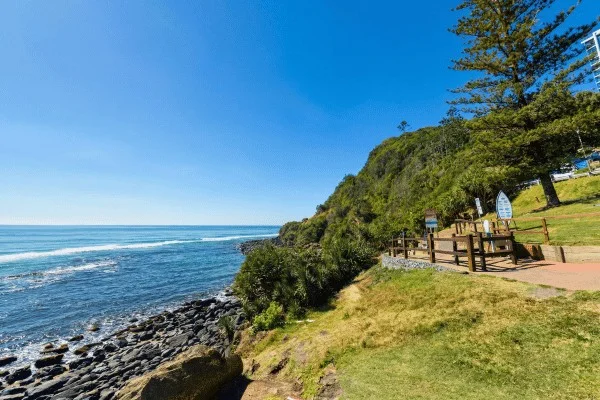
Burleigh also makes the coast's physical age easier to see. Its dark rocks came from volcanic activity associated with the ancient Tweed volcano, whose remaining central mountain is Wollumbin. Queensland Parks dates the relevant basalt flows to roughly 20 to 23 million years ago. Weathering and erosion later exposed the forms visible around the headland. The strip of green above the rocks has a different origin from the lawns and palms of a resort promenade.
For a visitor, this changes what deserves attention. The coast contains places with different ecological and cultural histories, even when a photograph compresses them into one long beach. Reading local interpretation at a headland, and using Traditional Owner accounts when they are available, gives the setting more depth than a sequence of modern development dates can provide.
Rocky shore and vegetation at Burleigh provide a different view of the Gold Coast from its tower districts.
A bridge helped make a holiday town possible
The village that became Surfers Paradise was once called Elston. Its later success depended partly on an ordinary problem: reaching it. Gold Coast Libraries records the opening of the Jubilee Bridge over the Nerang River in 1925. The crossing improved the road connection along the coast, helping visitors and businesses reach a place that had previously been less convenient to access.
Transport belongs near the centre of this story because a beach needs a route to its customers before it can support a resort economy. Accommodation investors need guests to arrive reliably. Shops need deliveries. People planning a short holiday must be able to imagine the journey as manageable. A bridge does less visible promotional work than a glamorous hotel, but both can change the prospects of a settlement.
Looking at the developed waterfront today, it is easy to assume that popularity followed automatically from sunshine and sand. The earlier history suggests something more practical. Natural appeal mattered, while access determined how readily people could turn that appeal into an actual visit. The later city grew from decisions about movement as much as from decisions about views.
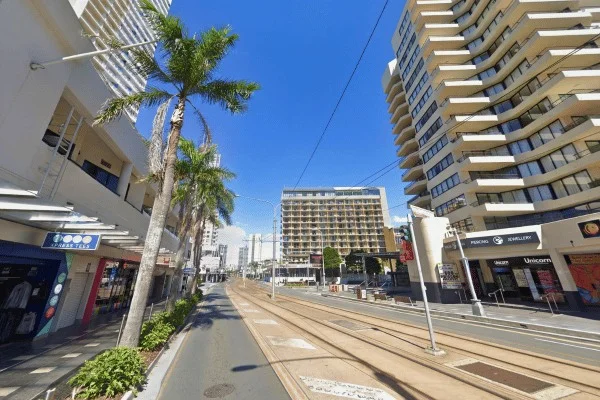
How Surfers Paradise got its name
Jim Cavill opened the Surfers Paradise Hotel in 1925. Its name promised a holiday experience more clearly than Elston did. After a campaign to change the locality's name, Surfers Paradise became official in 1933. Gold Coast Libraries notes that Sea Glint had also been considered. That alternative is a useful reminder that familiar place names can emerge from negotiation and publicity, then begin to feel inevitable once maps repeat them.
Cavill had arrived in Elston in 1923. His activities extended beyond running the hotel: he was involved in establishing the Surfers Paradise surf lifesaving club in 1929. Accommodation and beach life were developing together. A visitor arriving at the hotel was also entering a place where organised recreation and rescue work were helping define what a seaside community should look like.
The name still identifies both a suburb and a holiday promise. Someone can arrive expecting the second and encounter the ordinary traffic, apartment entrances and working businesses of the first. Paying attention to both makes Surfers Paradise more interesting than judging whether it matches a postcard.
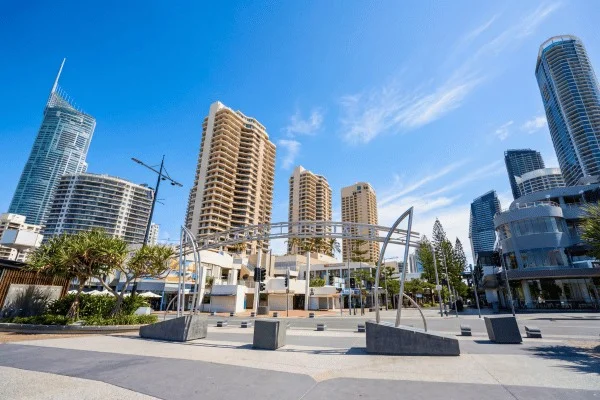
Beach culture needed people working on the shore
Surf culture often appears in photographs as individual confidence: a board, a breaking wave, a person at ease in the water. The beach also relies on collective work. Surf lifesaving clubs organised rescue skills and competition, while the holiday economy depended on people maintaining accommodation, preparing food and keeping public spaces usable. These jobs can disappear from an image that sells complete relaxation.
Historical photographs are particularly helpful here. The State Library of Queensland's Gold Coast collections include work by Graham Burstow, who photographed beach and holiday life across several decades. Groups gathering, people waiting and the everyday rituals of leisure give a less polished view than an advertisement. They show how much of a seaside holiday happens between the moments that become promotional images.
You can apply the same attention during a visit. Notice how people share shade and how the beach changes between a busy bathing area and a quieter stretch. The resort is a place used by residents as well as visitors. Its social life is easier to understand when the sea is part of an ordinary day rather than a backdrop reserved for holidays.
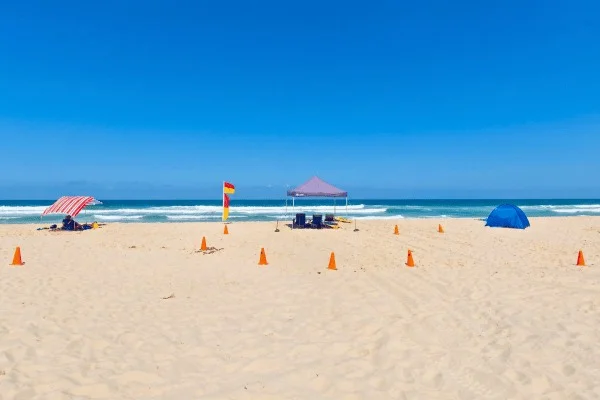
The postwar holiday changed the shape of the city
After the Second World War, the coastal holiday economy expanded alongside property development. The State Library of Queensland describes the growth of motels, new residential areas and canal development during this period. The name Gold Coast gained currency as the district's land became increasingly valuable. In 1959, the Gold Coast was proclaimed a city.
These changes affected what a holiday stay could be. Roadside accommodation suited a different pattern of travel from a single destination hotel. Apartments let people imagine returning regularly, or owning part of the holiday setting themselves. A view of the water could be sold through a room booking, a property advertisement or a promise of permanent relocation. Tourism and residential aspiration became difficult to separate.
A motel and an apartment tower also organise the guest's experience differently. A motel puts the car and room close together. A tower directs guests through a shared entrance and lifts before opening onto a private view. You can see those priorities in the buildings themselves. The comparison helps explain why architecture matters to a holiday city: it determines how people arrive, encounter one another and reach the public spaces they came to enjoy.
Balconies and shared entrances help explain what these apartments offered their first occupants. Consider how a balcony’s private view relates to the public shore below. The city's architecture records changing expectations about privacy, convenience and how close everyday living should come to a holiday.
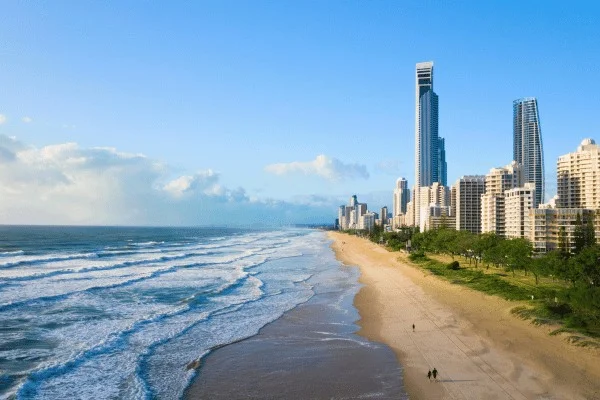
Kinkabool and the Gold Coast skyline
Kinkabool is an early example of the Gold Coast's move into tall apartment buildings. Gold Coast Libraries identifies it as the city's first high rise and records developer Stanley Korman's role in the project. The building's amenities helped present apartment living as a modern holiday proposition. Compare its scale with the lower accommodation that preceded the later tower clusters.
The architectural interest lies in a change of scale. Stacking accommodation could place many more households close to the same stretch of beach. Height also made the view part of the product. Once looking out over the coast became a selling point, a building's relationship to surrounding development mattered as much as its distance from the sand.
A historical reading of the skyline therefore needs older, smaller towers as well as the newest silhouettes. The first experiments explain the commercial logic that later buildings enlarged. For more of the local context behind the streets, the paid Gold Coast audio walking tour can accompany time spent exploring the city.
Even parking became part of the publicity
The Surfers Paradise Meter Maids grew from a dispute over parking meters introduced in late 1964. Businessman Bernie Elsey promoted the idea of women adding coins to meters before motorists received penalties. Gold swimsuits and tiaras made the campaign conspicuous. Gold Coast Libraries distinguishes these privately organised Meter Maids from the council's later Courtesy Maids, a distinction often lost when the story is retold.
The campaign turned a potential annoyance into a photograph that could travel. It also reveals the gender expectations behind some of the resort's best remembered imagery. Women's appearance became a vehicle for selling hospitality and welcome. A historical account can recognise the campaign's publicity success while asking who was expected to perform that welcome and how their work was represented.
This episode fits the broader pattern of Gold Coast promotion. The district repeatedly used a memorable image to attract attention to a practical commercial concern. A parking meter is a small piece of street furniture, but the response to it tells us something precise about the businesses that wanted visitors to feel wanted.
Look beyond a single version of the Gold Coast
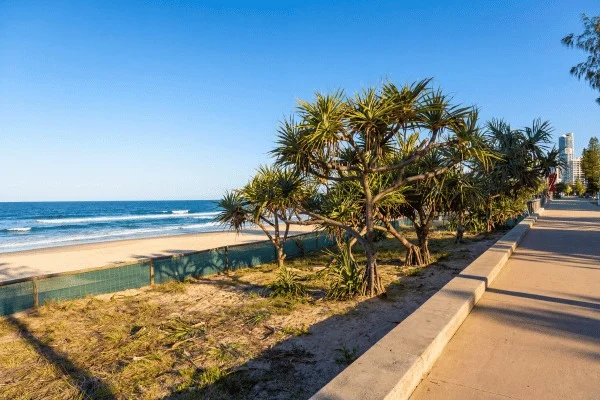
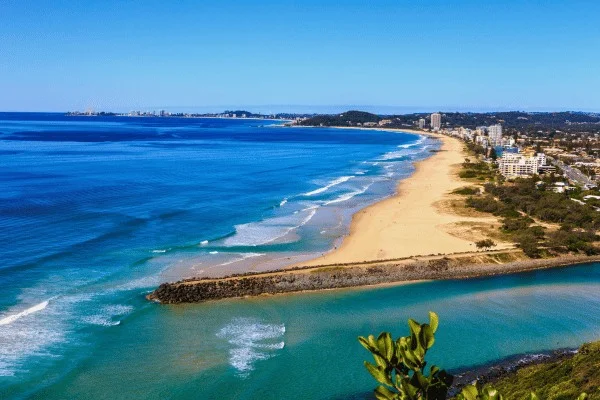
The skyline is one way to recognise this coast. A river mouth, a rocky headland or a residential street offers another. Putting them in the same mental picture prevents the busiest tourist district from standing in for the entire city. Development has taken different forms in different places, and a photograph looking along the shore can reveal those changes more clearly than a close view of one tower.
Allow some time to look at the relationship between built areas and the water. Compare a promenade designed for lingering with a street arranged around movement. Read a building's date when one is displayed. These small observations make the history tangible without requiring every moment of a visit to become a lesson.
Older photographs can make the comparison more precise. Look for a fixed point such as a headland, then compare the amount of space occupied by buildings in different periods. A changed skyline is obvious; a lost gap between buildings or a wider road is easier to miss. Avoid assuming that every change belongs to one continuous plan. Different owners and public bodies made decisions at different times, and the present view contains the results together.
The Gold Coast has repeatedly changed the way it presents itself. The older coast remains present beneath that commercial history, while residents continue to use the same streets and beaches that visitors come to see. Explore the city's local stories with Trippy Tour Guide's paid Gold Coast walking tour, then leave room in the day to notice how those different uses meet.
Frequently asked questions
What was Surfers Paradise called before 1933?
The locality was called Elston before it took the name Surfers Paradise in 1933. Jim Cavill's hotel had already used the name, giving the campaign a recognisable tourism identity.
Why are there so many towers beside the beach?
Apartment development allowed more accommodation near the shore and made elevated sea views part of what developers could sell. Early buildings such as Kinkabool help explain the pattern behind the much larger skyline.
Is the city's history mainly about tourism?
Tourism explains much of its recent built form, but the coast has a much older geological and Indigenous history. Burleigh's headland makes those longer histories particularly relevant to understanding the setting.
How can I explore the history during a visit?
Combine time observing the waterfront and architecture with local historical interpretation. The paid Trippy Gold Coast walking tour provides an audio option. Check its product page for the current experience details before purchasing.
Why is the Gold Coast called the Gold Coast?
The name gained currency as coastal land became more valuable during the growth of the holiday economy after the Second World War. Motels, housing and canal development were changing the district at the same time. Gold Coast was proclaimed a city in 1959. Its use reflects the district’s changing commercial identity during a period of rapid development.